
Showing posts with label architecture. Show all posts
Showing posts with label architecture. Show all posts
Sunday, May 15, 2011
St. Ita's Church
By happenstance, each condo I have bought in Chicago has been across from a major church. When I lived in Lakeview, Our Lady of Mount Carmel was across the alley. In Uptown, I was across the street from St. Mary of the Lake. We currently are across the street from St. Ita's, which is our view from our bedroom and living room windows.


Saturday, May 7, 2011
The Globalisation of Feng Shui
"Practised in China for over 6,000 years, feng shui has played a significant role in shaping the country’s architecture. Despite attempted suppression during the Cultural Revolution of the 1960s, feng shui has not only remained prominent in its country of origin, but has become well known across the Western world too."
Sunday, October 31, 2010
An Analysis of Classical Elements in the London Guarantee and Accident Building

This analysis discusses the classical elements found on the building and analyzes the success of implementing classical design in an early skyscraper.
Sunday, October 10, 2010
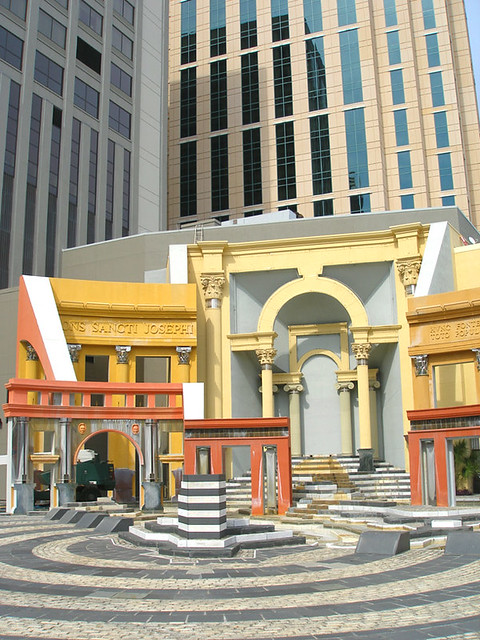
Piazza d'Italia: A Paradigm Shift Away From Modernism
 |
| source: perfectsnap on flickr |
The Piazza d’Italia was designed by Charles Moore in conjunction with New Orleans based Perez Architects. The plaza was commissioned to recognize the contributions of Italian culture in New Orleans. The plaza was part of a larger plan to rejuvenate part of the warehouse district. Perez Architects created infill buildings along Tchoupitoulas Street, assisting with the rehabilitation of historic buildings on the block. The Piazza d’Italia was placed behind these buildings, in the center of the block. It was to be an unexpected plaza, like the squares in Europe that open up from a narrow road or alley. Built from 1975 – 1979, the Piazza d’Italia fell almost immediately into disuse and disrepair. Partial renovations were done in 2004 in conjunction with the opening of the adjacent Loews Hotel.
In design, the Piazza d’Italia and Charles Moore are firmly associated with Postmodernism. At least into the 1950s, the Modern movement was the dominant theory in design. Architects such as Robert Venturi and Charles Moore pushed against Modernism, feeling that it defined what design should be and excluding everything that did not fall within that definition. Postmodernism rejected absolute distinctions, strict definitions, and restrictive rules. Moore in particular was concerned about what was excluded by Modernism. He preferred to consider what could be included by design, not excluded. In this light, Postmodernism embraced the ornament and historical architecture that had been explicitly rejected by Modernism.
Even in a field of architects rejecting the dominant Modernist paradigm, Moore stood out with designs that ranged from whimsical to flamboyant, including projects such as Sea Ranch, the UCSB Faculty Club, and Kresge College at UCSC. The Piazza d’Italia does not represent the initiating project in Postmodernism, but rather it is one of the prominent defining moments in the rejection of Modernism. Even though some of Moore’s original design was rejected as being too tacky, the final project was a vivacious compilation of classical Roman references with contemporary materials and methods. Not only was the Piazza ornamented, it appeared to be build of ornament. Lacking any sense of massing, the space reads more as an event than a built form. Much of previous Postmodern work, even Moore’s projects, had involved adding various elements to buildings to create an architecture of inclusion. The Piazza d’Italia could be regarded as the endpoint of that process, rejecting all elements of Modernism.
The Piazza d’Italia was both acclaimed and reviled by critics. Ten years later, Charles Moore acknowledged both his supporters and detractors, feeling that both the amount and ferocity of the debate indicated the importance of the subject. This is the essence of the paradigm shift initiated by Postmodernism. With its use of historical elements and ornament in a distorted or playful way, Postmodernism resembles a Mannerist style more than a defined movement. Its exaggerated approach demands response and invites discussion. This shift has had an enduring impact in architecture. While Modernism has not completely gone away, it no longer has the prescriptive power it once had. However, no one movement has secured the dominant position previously held by Modernism. Postmodernism had similar effects in a variety of disciplines, from literature to gender theory. As an example of the interrelated influences of design and society, architectural design embraced greater plurality in parallel to a movement towards more diversity in society.
Subscribe to:
Posts (Atom)